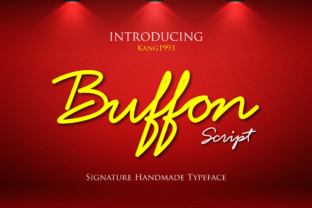
Buffon: A Detailed Look at Kang1993's Handcrafted Script
In a digital landscape saturated with mass-produced typefaces and algorithmic design tools, finding a font that balances distinct personality with professional reliability can be a challenge. This is where Buffon enters the conversation. Created by the designer Kang1993, this handcrafted script is not merely another decorative element for a website; it represents a deliberate move away from the uniformity of standard libraries toward something more organic and human-centric.
For professionals, creators, and small business owners who understand that typography sets the emotional tone of their content, evaluating Buffon requires looking beyond surface aesthetics. It is a tool designed to convey warmth, craftsmanship, and a personal touch. Whether you are a blogger seeking to establish a unique voice or an entrepreneur building a brand identity, understanding the specific utility of Buffon is essential before integrating it into your workflow.
The Artistry Behind the Design
At its core, Buffon distinguishes itself through its "handcrafted" nature. Unlike vector-based fonts that often feel sterile or overly polished, this script mimics the natural irregularities of ink on paper. The strokes vary in thickness, the connections between letters flow with a fluid rhythm, and the overall character feels as though it was drawn by hand rather than generated by code.
This approach offers a significant advantage in an era where consumers are increasingly skeptical of corporate impersonality. When used correctly, Buffon signals authenticity. It suggests that there is a real person behind the brand, a creator putting thought into every detail. For freelancers and educators, this quality is invaluable. It allows them to present their work not as a commodity, but as a curated experience.
The design philosophy here aligns well with current trends in branding that favor "human-first" communication. However, it is important to note that this aesthetic comes with specific constraints. The script is not designed for technical precision or high-volume data display. Its strength lies in evocation and atmosphere, making it a powerful asset for storytelling but less suitable for rigid structural tasks.
Practical Applications and Use Cases
To determine if Buffon fits your project, one must look at where it performs best in real-world scenarios. The versatility of a script font often depends entirely on context. In this regard, Buffon finds its most effective applications in areas where visual hierarchy and emotional connection take precedence over pure information density.
- Branding and Logos: Small businesses and boutique brands often struggle to stand out against generic templates. Buffon provides a distinctive mark that can serve as a logo or a primary brand identifier. Its unique letterforms help create immediate recognition without relying on complex graphic elements.
- Editorial and Blogging: For publishers and bloggers, headers and pull quotes are prime opportunities to inject personality. Using Buffon for article titles or section dividers can break up dense text and invite the reader deeper into the content. It works particularly well for lifestyle, travel, and creative industries.
- Marketing Materials: Flyers, social media graphics, and email newsletters benefit from the warm, inviting nature of the script. It softens the hard edges of promotional copy, making calls to action feel more like invitations than demands.
- Educational Content: Teachers and course creators can use Buffon to make learning materials feel more accessible and less intimidating. The friendly appearance of the letters can reduce the cognitive load for students, creating a more welcoming educational environment.
However, the limitations are equally important to consider. Buffon should generally be avoided for body text, especially on mobile devices where legibility is paramount. The intricate details of a handcrafted script can become muddy at smaller sizes, leading to user fatigue. Furthermore, for industries requiring a sense of strict authority, such as finance or legal services, the casual nature of the font might undermine credibility. It is a tool for connection, not for command.
Evaluating Usability and Technical Performance
From a technical standpoint, the usability of any font is determined by its consistency, weight distribution, and rendering capabilities. As a handcrafted script, Buffon relies heavily on the quality of its kerning pairs and ligatures. Good design ensures that even when letters connect, they do not collide awkwardly or create unintended shapes.
When integrating Buffon into a web environment, performance becomes a key factor. While modern web fonts are optimized for speed, custom scripts can sometimes introduce latency if not served correctly. Professionals should ensure that the font file is compressed and loaded asynchronously to maintain fast page speeds. Slow loading times can negate the positive psychological impact of the design, causing users to bounce before they even see the content.
Another aspect of usability is flexibility. Does the font family offer multiple weights? Does it include a cursive alternative? A robust script font usually provides enough variation to handle different levels of emphasis without losing its character. If Buffon is limited to a single style, it restricts the designer's ability to create dynamic layouts. For long-term projects, having a range of options within the same family is crucial for maintaining visual interest across various screen sizes and mediums.
Long-Term Value and Brand Consistency
Investing in a specific typeface like Buffon is a strategic decision that impacts your brand's longevity. Trends in typography shift rapidly, moving from geometric sans-serifs to neo-grotesques and back again. However, handcrafted scripts often possess a timeless quality because they mimic the enduring art of handwriting. They rarely feel "dated" in the same way that highly stylized digital fonts might.
For entrepreneurs and marketers, this timelessness translates to cost savings and brand stability. Once a client adopts Buffon as part of their visual identity, they are unlikely to need a complete overhaul in a few years. The font remains relevant because it appeals to a fundamental human appreciation for craft and imperfection. This consistency helps build trust with the audience, as they recognize the visual language associated with the brand over time.
Nevertheless, reliance on a single font can lead to monotony. To maximize long-term value, Buffon should be paired with complementary typefaces. A clean, neutral sans-serif often serves as an excellent counterpoint, providing the necessary structure to balance the expressive nature of the script. This combination allows for a sophisticated hierarchy where Buffon shines in headlines while the supporting font handles the heavy lifting of readability.
Who Should Consider Buffon?
Ultimately, the decision to use Buffon comes down to your specific goals and audience. It is an ideal choice for individuals and businesses that prioritize authenticity and creativity. If your work involves storytelling, community building, or artistic expression, this script can elevate your presentation significantly.
Freelancers in creative fields, such as photographers, illustrators, and designers, will find Buffon particularly useful for portfolios and personal websites. It acts as a subtle signature, reinforcing the idea that the work presented is unique and personally crafted. Similarly, small business owners in sectors like bakeries, boutiques, and artisanal goods can leverage the font to communicate quality and tradition.
Conversely, if your primary goal is maximum scalability for large enterprises or clarity for data-heavy interfaces, Buffon may not be the right fit. It requires a thoughtful application strategy. It is not a "set it and forget it" solution; it demands attention to spacing, size, and pairing to function effectively. But when applied with care, the result is a visual experience that feels genuine and engaging.
In conclusion, Buffon stands out as a compelling option for those seeking to add a human element to their digital presence. Created by Kang1993, it offers a blend of artistic flair and practical utility that is rare in the world of open-source and commercial fonts. By understanding its strengths and respecting its limitations, professionals can harness its power to create content that resonates deeply with their audience.