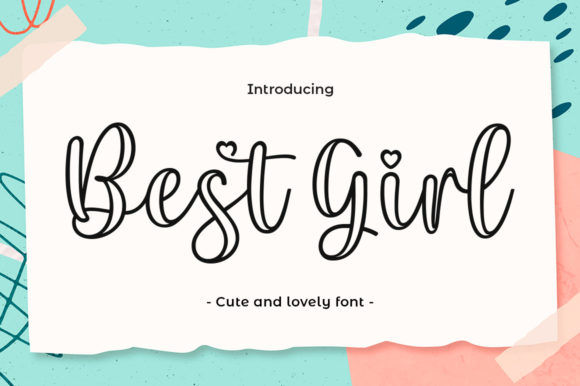
Best Girl: A Comprehensive Evaluation for Designers
In the vast landscape of typography, selecting the right typeface is rarely a matter of simple preference; it is a strategic decision that defines the visual identity of a project. Best Girl has emerged as a notable option for designers seeking a blend of modern chic and traditional refinement. As a script font, it occupies a specific niche where readability must coexist with high-end aesthetics. This evaluation explores the technical specifications, stylistic attributes, and practical applications of Best Girl to help you determine if it aligns with your design goals.
Understanding the Character of Best Girl
At its core, Best Girl is designed to emanate sophistication and elegance. Unlike casual handwriting scripts that mimic quick pen strokes, this typeface presents a more curated appearance. The letterforms are constructed with a sense of rhythm and flow, suggesting a deliberate and polished approach to communication. The primary appeal of Best Girl lies in its ability to convey a message of luxury without sacrificing legibility.
The font's structure relies on varying stroke weights that create a dynamic contrast between thick downstrokes and delicate upstrokes. This variation mimics the natural pressure of a calligraphy nib but is optimized for digital and print reproduction. The result is a text style that feels both organic and controlled. When used correctly, it elevates the perceived value of the content it accompanies, making it an ideal candidate for projects where tone and atmosphere are paramount.
Technical Features and Accessibility
One of the most significant advantages of Best Girl from a technical standpoint is its encoding method. The font utilizes PUA (Private Use Area) encoding. For designers unfamiliar with this terminology, this means that the font file reserves specific code points to house extended character sets, including stylistic alternates, swashes, and ligatures. While standard Unicode fonts rely on specific code blocks defined by the Unicode Consortium, PUA encoding allows the designer to include a broader range of glyphs within a single file.
- Access to Glyphs: The PUA encoding ensures that all specialized characters are accessible without requiring multiple font files or complex workarounds.
- Stylistic Flexibility: Users can easily access swashes—extended flourishes at the beginning or end of letters—and alternate forms that change the shape of specific characters to improve spacing or add visual interest.
- Ligature Support: The font includes built-in ligatures that connect certain letter pairs, smoothing the transition between characters and enhancing the fluidity of the script.
This level of control is particularly beneficial for professional designers who need to fine-tune the kerning and overall texture of their layouts. However, it also requires a certain level of proficiency in typography software to fully utilize these features effectively.
Strategic Applications and Ideal Use Cases
Determining whether Best Girl fits a project depends heavily on the context of the communication. Because of its refined nature, it is not a universal solution for all design challenges. It excels in scenarios where the goal is to establish an immediate sense of prestige or intimacy.
For branding purposes, Best Girl is well-suited for logos, monograms, and wordmarks associated with the fashion, beauty, and hospitality industries. A wedding invitation suite, for instance, benefits greatly from the romantic yet structured feel of this typeface. The elegant curves and sophisticated alternates allow for customizations that make each piece feel unique and hand-crafted.
In editorial design, the font serves as an excellent choice for pull quotes, chapter headings, or section dividers. Using Best Girl as a display element breaks the monotony of body text while maintaining a cohesive visual language. Its high legibility at larger sizes makes it effective for headlines, provided the surrounding layout allows for sufficient white space to prevent visual clutter.
Evaluating Tradeoffs and Limitations
While Best Girl offers distinct aesthetic advantages, it is important to acknowledge the limitations inherent to script typefaces and this specific implementation. The most significant consideration is legibility at small scales. Script fonts generally struggle when reduced to very small point sizes, as the intricate details and thin strokes can become indistinct or disappear entirely. Therefore, Best Girl should be avoided for dense body copy or technical documentation where clarity is the primary objective.
Additionally, the reliance on PUA encoding can present compatibility challenges. While modern operating systems and design software handle PUA fonts well, there may be instances where the font fails to render correctly on older devices or specific web environments that do not support private use area characters. Designers must test the font across various platforms before finalizing a project to ensure consistent rendering.
Another factor to consider is the potential for overuse. The "chic" and "refined" qualities of Best Girl can quickly become cliché if applied indiscriminately. If every headline in a brand's collateral uses this script, the uniqueness of the design diminishes. It is often more effective to pair Best Girl with a neutral sans-serif or serif body font to create a balanced hierarchy.
Comparative Considerations and Alternatives
When evaluating Best Girl, it is helpful to compare it against other script fonts in the market. Some alternatives may offer better web font optimization or broader Unicode support, which could be critical for responsive web design. Fonts that are strictly Unicode-compliant often provide easier integration into content management systems and require less manual intervention to display special characters.
If the project requires a more casual or handwritten feel, a different category of script might be more appropriate. Best Girl is formal and structured; it does not possess the loose, energetic quality of brush scripts or the chaotic charm of marker-style typefaces. Conversely, if the goal is maximum readability in a paragraph setting, a dedicated humanist sans-serif would likely outperform Best Girl in terms of efficiency and user experience.
Decision-Making Insights for Designers
To decide if Best Girl is the right tool for your next project, ask yourself specific questions regarding the audience and the medium. Is the target demographic expecting a premium experience? Does the medium allow for large-scale presentation of the text? Will the font be viewed primarily on mobile screens where screen real estate is limited?
If the answer to these questions leans towards yes, Best Girl is a strong contender. Its combination of stylistic alternates and PUA encoding provides the flexibility needed for high-end customization. However, if the project demands broad accessibility, extensive body text, or a more utilitarian tone, you should explore alternatives that prioritize function over form.
Ultimately, the success of using Best Girl depends on how thoughtfully it is integrated into the overall design system. It is not merely a decorative element but a voice that speaks of elegance and attention to detail. By understanding its capabilities and constraints, designers can leverage Best Girl to create work that resonates with sophistication and leaves a lasting impression.